

Spoken Beta V0.8.8: Hume AI, Automated Custom Voices, and Marketing Kits
This release brings major upgrades to how your Spoken projects are cast, customized, and shared. With v0.8.8, we’re introducing a new voice service into both the voice library and custom voice generator, groundbreaking one-click custom voice automation for every character in your story, and marketing kits to equip authors with high-value Spoken assets built for promotion.

This release brings major upgrades to how your Spoken projects are cast, customized, and shared. With v0.8.8, we’re introducing a new voice service into both the voice library and custom voice generator, groundbreaking one-click custom voice automation for every character in your story, and marketing kits to equip authors with high-value Spoken assets built for promotion.
Hume AI

We've now integrated Hume AI, featuring their emotionally intelligent voice generation, into both our voice library and custom voice tools. Hume-powered voices support a broad range of character types, accents, and emotional performances.
Automated Custom Voices

Automated Custom Voices allows authors to choose between 11Labs or Hume voices and, with one click, have Spoken analyze their story, identify every character, and generate a unique custom voice for each one. No manual voice selection—just an instant, ready-to-edit cast waiting for you in Passage Editing. Available to use across any of our narration formats.
Child and Teen Character Voices
We’ve added dedicated Child and Teen voices to the Spoken voice roster—ideal for middle grade fiction, YA, or flashback scenes. These new voices are available via Hume.
You’ll find these voices:
Auto-selected when characters are detected as children or teens.
Available in the voice picker listed as “Child”.
Want your young adventurer to sound exactly right? Now they can.

Marketing Kit
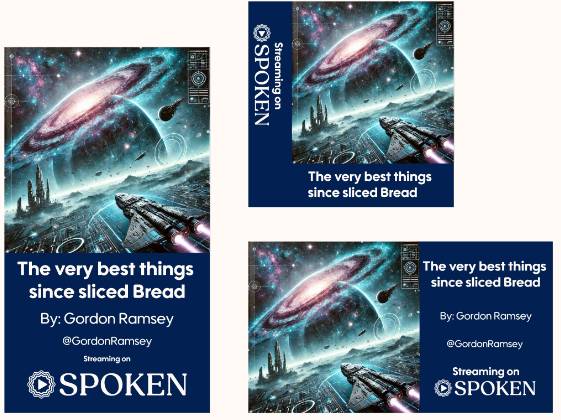
You can now promote your Spoken story with professionally packaged assets that come ready to share.
Every published project automatically generates a Marketing Kit with branded cover art formatted for social media. Find your kit on your Project Page after publishing.

Note. The project must be set as public, and have mastering enabled.
Formats available:
Square Image (Instagram)
1080x1920 Vertical Format
1600x900 Horizontal Format
Global Speed and Volume changes
Instead of adjusting speed and volume one passage at a time, you can now set global speed and volume for each character directly from the Voices tab. Just select the voice you want, make your changes, and click Continue—your adjustments will apply across your entire project.

Other Fixes and Changes
We’ve removed the “Basic,” “Enhanced,” and “Advanced” voice tiers. All voices are now categorized simply as Premium or Voice Actor for a cleaner, more consistent experience and higher quality voice choices.
We’ve also removed the Performance Insights button from user profile pages due to its inaccuracy. Users should rely on the play and like counts on project pages.
Lastly, we removed estimated costs of narration because we're still evaluating the options for how best to have our users pay for narration.

Spoken Into Existence Ep. 3: Book Trailers – A Next-Level Marketing Tool for Authors
In Episode 3 of Spoken Into Existence, authors Joseph Nassise and Tom Leveen joined the Spoken team—Stacy Smith Rogers, Patrick Wimp, and Joshua David Pivato—for a creative deep-dive into something every author needs to be thinking about right now: how to to support your story the way people discover today.
This wasn’t just a conversation about writing. It was a working session—an inside look at how a story can become a multi-sensory asset that builds anticipation, extends your brand, and helps new listeners discover your work.
If you’re not thinking about Spoken’s trailer creation as part of your book launch strategy, Joe and Tom are, and this episode might change your mind.
In Episode 3 of Spoken Into Existence, authors Joseph Nassise and Tom Leveen joined the Spoken team—Stacy Smith Rogers, Patrick Wimp, and Joshua David Pivato—for a creative deep-dive into something every author needs to be thinking about right now: how to to support your story the way people discover today.
This wasn’t just a conversation about writing. It was a working session—an inside look at how a story can become a multi-sensory asset that builds anticipation, extends your brand, and helps new listeners discover your work.
If you’re not thinking about Spoken’s trailer creation as part of your book launch strategy, Joe and Tom are, and this episode might change your mind.
From Audio to Audience: Spoken’s Tools for Author Visibility
Today’s indie authors are operating in a noisy digital marketplace. Publishing a great story is the baseline. Marketing that story in a way that commands attention—that’s where authors win or fade into the background.
A trailer bridges that gap. In a world dominated by short-form video and sound-rich content, a Spoken Book Trailer acts as a cinematic handshake: fast, emotional, and unforgettable.
Done well, a trailer becomes:
A teaser that builds buzz before your launch
A highlight reel for press, newsletters, or podcasts
A social-ready ad that doesn’t feel like an ad
A visual companion to your audio-first storytelling
And here’s the key: it’s not just about aesthetics. It’s about converting intrigue into listens.
Inside the Trailer Lab: Building the Hook for Sackcloth and Blood
In this episode, the team collaboratively began crafting the trailer for Sackcloth and Blood, Joe and Tom’s supernatural thriller set in the American Southwest.
The process? Fast-paced, focused, and rich with intent.
Key takeaways from the creative session included:
Anchor imagery: The authors centered on a scene at the mouth of a cave—a foreboding visual with a looming, monstrous silhouette. It’s atmospheric and suspenseful, setting the tone immediately.
Gradual character reveal: Rather than opening on Moxy (the story’s protagonist), the team debated ways to withhold her full presence—using reflection, shadow, or voice restraint to build tension.
Music direction: The team drew inspiration from John Carpenter’s synth-heavy scores and the haunting swagger of Sympathy for the Devil, emphasizing tone over tempo.
Scene construction: Should it be a fluid, one-shot moment? A staccato montage? The group leaned toward a hybrid—brief glimpses layered with rising momentum, culminating in a visual and vocal reveal.
This was a live collaboration between the authors and the Spoken team, blending creative vision with marketing strategy.
For Indie Authors, This Is a Competitive Edge
Here’s what sets a Spoken Book Trailer apart from the typical static promo asset: you’re not adapting your story for someone else’s template. You’re shaping the trailer as part of the narrative experience.
Because Spoken is built for audio-first storytelling, our tools and workflow are aligned to support exactly this kind of creative extension—from voice to visual to discovery. We make it easy for authors to create, distribute, and promote work that doesn’t just sound good—it stands out.
And while traditional publishing may treat trailers as rare perks, at Spoken they’re part of the playbook for the authors we spotlight.
Missed Episode 1 & 2? Make sure to catch up. You’ll want to catch the next one. The Sackcloth and Blood trailer reveal is coming soon—and it’s proof of what’s possible when authors and storytellers think like showrunners.
The future of storytelling is author-led. At Spoken, we’re helping you launch that future.
Learn about Joseph Nassise: https://josephnassise.com
Learn about Tom Leveen: https://tomleveen.com
Try Spoken: https://ihave.spoken.press

Spoken Into Existence – Ep. 2: Voice Casting an Audiobook
What if the most powerful rewrite isn’t on the page—but in the voice that reads it?
Spoken Into Existence returns this week with a question that reshapes how we craft character: If the audience’s first experience of your character is through their voice—how does that change the way you bring them to life?
It’s not just a fun narrative exercise. It’s a glimpse into a revolution. And at the center of it all… Voice! Real, resonant, character-crafting, audience-immersing voice.
What if the most powerful rewrite isn’t on the page—but in the voice that reads it?
Spoken Into Existence returns this week with a question that reshapes how we craft character: If the audience’s first experience of your character is through their voice—how does that change the way you bring them to life?
It’s not just a fun narrative exercise. It’s a glimpse into a revolution. And at the center of it all… Voice! Real, resonant, character-crafting, audience-immersing voice.
The Alchemy of Audio
Every author knows the high-wire act of character development. But what happens when that character finally speaks? When Moxie Kirk—the rebellious punk teenager War incarnate—rasps her first line, or Sister Mary Agnes lights up the page with a cigarette and a sermon?
Joseph Nassise and Tom Leveen are in Spoken’s Voice Studio, playing casting directors to a cast of apocalyptic misfits. With Spoken's library of voices—ranging from rich, sonorous narrators to custom-built character voices—they explore how audio can transform the listener’s experience. And more importantly, how it can deepen the author's own understanding of their work.
“You start asking questions you didn’t even write—like where was this character educated? What accent shaped them? It forces you to finish the character in ways text never demanded,” reflect Joe and Tom.
Exactly. And that’s the point.
Voice as Performance. Voice as Tool. Voice as Freedom.
Some authors hear their characters before they even write them. Others are more structure-forward—voices emerge in the remix. Spoken empowers both styles with options:
Browse the voice library and match a gritty Western outlaw to your space opera villain.
Generate custom voices that age, twist, and shape your protagonist.
Clone your own voice, if you dare to go full memoir and narrate with a personal touch.
Let AI suggest matches, sit back, and enjoy the magic of automation.
The best part? No casting calls. No studios. No second mortgages.
From Page to Performance
In a world where over half of adult readers now consume stories via audio, voice isn’t just an enhancement. It is the medium. It shapes perception, sets mood, and defines tone. The right narrator doesn’t just read your story—they translate it.
This is the power Spoken brings: turning indie authors into audio auteurs, giving them tools previously reserved for Hollywood budgets. As Joseph and Tom demonstrate, casting isn’t about convenience—it’s about connection.
“We need these characters to sound different enough,” Joseph explains, “so they don’t blend into one another. The voice is the listener’s anchor.”
And when that anchor is right? The story soars.
The Future is Spoken
For indie authors carving out space in a growing audiobook market, voice isn’t a luxury. It’s a lever. Spoken gives you grip.
Whether you want to:
Collaborate deeply like Joe and Tom, casting character by character.
Keep it simple and trust the top-matching AI voices.
Or blend both approaches with a personal twist...
Spoken's Studio gives you the stage.
Write the line. Pick the voice. Hit play. With Spoken, your story doesn’t wait to be read—it’s ready to be heard.
Watch Episode 2 of Spoken Into Existence now. Moxie and the nun are waiting.
Learn about Joseph Nassise: https://josephnassise.com
Learn about Tom Leveen: https://tomleveen.com
Try Spoken: https://ihave.spoken.press
By Storytellers. For Storytellers.
We believe that giving voice to writing isn’t just for those with resources to create elaborate productions or patience to navigate complex publishing hoops. Spoken was created by a small team of storytellers based in Portland, Oregon who believe in empowering self-publishers.