
Spoken Studio V2 — Magic Mode and Turnkey Full-Cast Audiobook Creation
Spoken Studio V2 introduces an entirely new operating mode — unique to Spoken — that changes how audiobooks are created from the ground up ….
This release marks the arrival of Magic Mode (Preview), a proprietary way of working inside Spoken. This isn’t a feature that improves individual outputs. It’s a method of production that orchestrates the entire performance, across characters, scenes, and chapters, in a way that was previously out of reach without extensive manual direction.
With Magic Mode enabled, you’re no longer constructing your audiobook piece by piece, solving for performance one passage at a time. Instead, Spoken approaches your project more holistically, carrying tone, emotion, pacing, and character intent across the work as a whole.
What used to take iteration now arrives far more complete. And the difference is immediate.
Alongside Magic Mode, V2 introduces a major advancement in voice modeling, a more capable Project Manager, editable summaries and metadata controls, refined credits handling, and a cleaner editorial flow — all supporting a higher standard of production for authors, producers, and publishers.
But the core shift with Spoken V2 is this:
Spoken now enables turnkey, Multi-Voice (digital full-cast) audiobook creation with a level of cohesion and performance that has historically required extensive manual direction, or remained out of reach entirely.
Magic Mode (Preview) — Studio-grade audiobooks in a click.
Available at no additional cost for a limited time
Enabled for multi-voice, character-driven works
Magic Mode is a behind-the-scenes orchestration system that aligns performance across your entire audiobook.
It ensures that characters, narration, tone, and pacing are not treated in isolation — but carried consistently from passage to passage, chapter to chapter.
It delivers:
True multi-voice (digital full-cast) cohesion across dialogue and character exchanges
Consistent emotional and tonal arcs throughout the work
Natural handling of dialogue tags
Improved pronunciation and contextual delivery
Expanded accent capability and expressive range
Cleaner, more consistent audio output
All right out of the gate, after hitting “Make Spoken”. For multi-voice projects, this results in a unified listening experience — where characters interact naturally within the same performance space.
You are no longer assembling the performance piece by piece, you are starting from something that already holds together.
A Shift in Production Dynamics
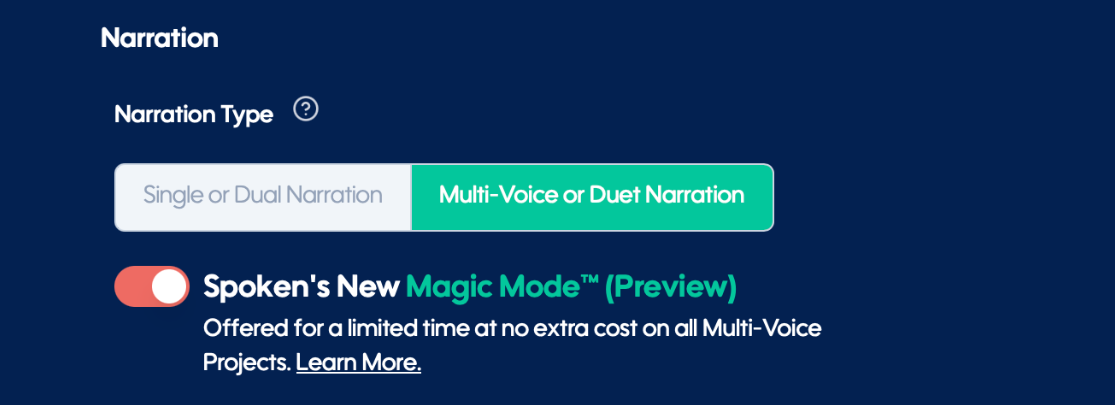
Before entering Magic Mode, authors now configure narration with the following options from the Project Manager tab:
Narration Type
Single / Dual Narration
Multi-Voice / Duet Narration
Magic Mode (Preview Toggle)
Optional feature to enhance multi-voice, character-driven projects
Available for a limited time at no extra cost
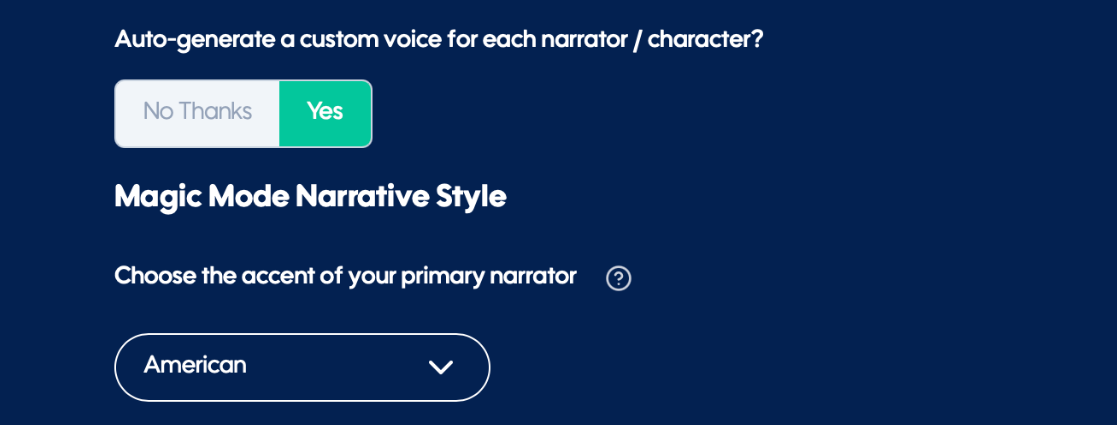
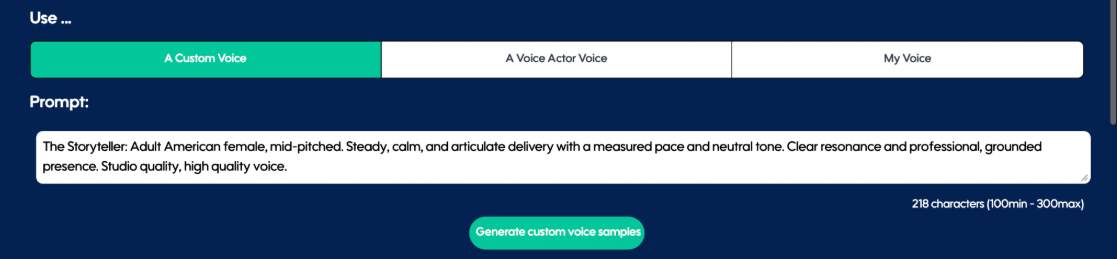
Auto Voice Generation
Automatically assign a unique voice to each narrator/character
Options: Yes / No Thanks
Primary Narrator Accent
Select accent for the main narrator (e.g., American)
Default Pacing
Choose narration speed/style:
Leisurely
Conversational
Brisk
Includes preview (“Pacing Sample”) option

A Shift in Production Dynamics
Spoken Studio V2 redistributes where effort is required.
There is more clarity upfront, and significantly less correction afterward.
For authors, this means less time refining individual passages.
For producers, it means working from material that is already structurally sound — refining rather than rebuilding.
For publishers, particularly across backlists, it means scalability and quality:
Fewer passes to reach production-ready quality
Greater consistency across chapters
A more predictable path from ingestion to distribution
The system now absorbs more of the complexity of getting narration right.
Next-Generation Voice Modeling — Deeper Character, Stronger Performance
Spoken Studio V2 is powered by a significant advancement in voice modeling — directly enhancing how performances are delivered across every project.
Character voices are now more defined, more expressive, and more adaptable to the writing itself.
This results in:
Stronger character identity across custom and actor voices
Greater emotional range and responsiveness to tone and context
More natural interpretation of dialogue and narration
Improved consistency across long-form passages and chapters
Cleaner handling of accents, phrasing, and intent
Custom voices, in particular, benefit from a more robust design, allowing them to carry nuance, personality, and variation in a way that holds up across an entire work.
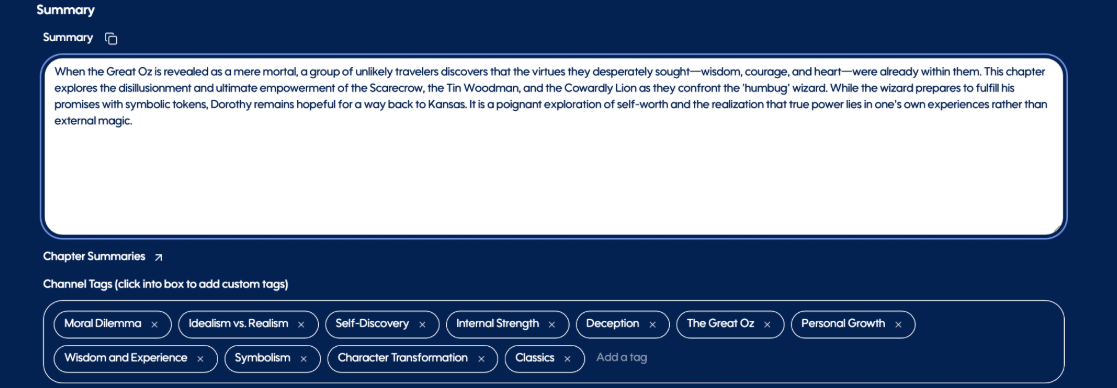
Project Manager — Structured Before You Start
The Project Manager now functions as a true pre-production environment.
Once analysis is complete, you can:
Edit and copy your project summary
Manage genre, channel tags, and comparables
Review and refine chapter summaries
This ensures every project is properly framed before narration begins.
Chapters / Installments — Clearer Alignment
“Installments” are now labeled Chapters / Installments across Studio — aligning with both serialized and traditional publishing workflows.
Magic Mode Editing — Controlled Insertion
To preserve structural integrity within Magic Mode, passage insertion is handled through:
Insert Passage →
Add before
Add after
This enables precise edits without disrupting the broader performance.
Publish Tab
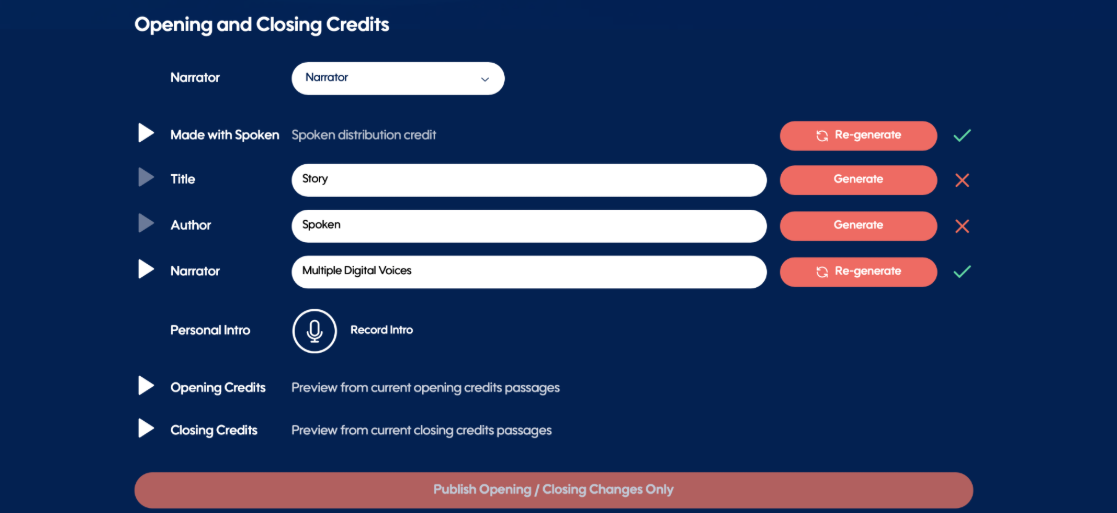
Opening & Closing Credits — Fully Managed
Introductions are now expanded into:
Opening & Closing Credits
Opening Credits are editable with clear indicators
Closing Credits are automatically generated and synced
You can:
Preview Closing Credits
Regenerate them
Publish them independently when updated (no charge)
Bugs & Improvements
General stability improvements across Studio
Refinements to narration consistency and edge-case handling
Performance optimizations across analysis and playback
New Tutorial
This new release doesn’t change much about how you interact with Studio — it’s more focused on improving the results. However, there are still a few new options and workflows you’ll come across.
To fully understand these changes and get up to speed quickly, check out the new tutorial here:
You can also always find the tutorial on the Create page in Spoken.
The Next Level
Spoken Studio V2 introduces a way of working that did not previously exist inside the platform, or broadly across digital narration.
It establishes a new baseline for what “first playback” can sound like, particularly in multi-voice storytelling where cohesion has historically been the hardest problem to solve.
This is a meaningful step forward for the industry, reshaping how authors, backlist holders, producers, and publishers scale high-quality audiobook production across multiple voices, with minimal editing time and a clear shift toward front-end creative preparation.
